Split is not just a destination. It is a base — and one of the best-positioned bases in the Mediterranean for exploring a wider region without a car.
Within two hours by public bus or ferry, you can reach a Roman fortress that held off the Ottoman Empire for twenty years, waterfalls that look better in autumn than summer, a mountain observatory open on Friday evenings where an astronomer will show you Saturn through a 16-inch telescope, a hilltop nature park that local hikers visit every single weekend, vineyards producing some of Croatia's finest red wine, and islands that were closed to the world for fifty years and still bear the traces of that isolation.
This is not an exhaustive guide to Dalmatia. It is a framework for the kind of traveller who prefers to find things properly rather than collect them quickly.
Biokovo and the mountain roads — several of the destinations in this piece involve mountain terrain. Biokovo Nature Park specifically has a single-lane mountain road that the park itself recommends non-confident drivers avoid. If you are not comfortable with narrow mountain driving, this is not a failure — it is good judgment. Organised minibus tours from Makarska exist specifically for this reason, and some local hiking clubs welcome visitors on their weekly outings. More on both below.
Dalmatia is longer than it looks — the province stretches from Zadar in the north to Dubrovnik and beyond in the south, with Split roughly in the middle. Pelješac and Mali Ston are geographically en route to Dubrovnik; Vis is the furthest inhabited island from the coast. Treating these as quick side trips underestimates the distances involved. The suggestions below are organised by realistic travel time from Split.
Klis Fortress Twenty minutes by local bus from Split city centre. One of the most important defensive fortresses in Dalmatian history, Klis held off Ottoman sieges for over twenty years under Captain Petar Kružić and his Uskoks. The scale of what was resisted here becomes physically clear when you stand on the walls and look out over the mountain pass below. Most visitors know it from Game of Thrones. This is the least interesting thing about it.
The fortress operates year-round. The spit-roasted lamb available near the entrance is not an optional extra. Going to Klis without eating it is, I will say plainly, a mistake.
Trogir Thirty minutes by bus. A UNESCO World Heritage town on a small island connected to the mainland by bridge, Trogir has been continuously inhabited since the third century BC. The old town is compact, the cathedral is extraordinary, and in October the ratio of locals to tourists is genuinely pleasant. A half day is enough; a full day is not wasted.
Omiš and the Cetina Canyon Forty-five minutes by bus. The old pirate town sits at the point where the Cetina river meets the Adriatic, with a dramatic canyon running inland behind it. The canyon trail is one of the more spectacular short hikes accessible from Split — river-level paths, cliff faces, occasional waterfalls. For those interested in traditional music, Omiš hosts the Klapa Festival every July; in October the canyon is simply beautiful and largely empty.
Zvjezdano Selo Mosor — the observatory nobody knows about This one deserves special mention because it is genuinely extraordinary and almost no visitor to Split has heard of it.
On the slopes of Mosor mountain, 22 kilometres from Split at an altitude of 702 metres, there is a community astronomy observatory run by the Zajednica tehničke kulture of Split. On Friday and Saturday evenings — summer hours 17:00 to midnight, winter hours 15:00 to 22:00 — an astronomer-guide leads visitors through the night sky. No booking required. Suggested donation is three euros for adults.
The observatory houses a 16-inch Meade telescope. On a clear evening you can see Saturn's rings, Jupiter's moons, and star clusters that are invisible to the naked eye. The view from 702 metres over Split and the islands is extraordinary even before dark.
Getting there without a car is possible: Promet city bus line 28 runs from Split to Gornje Sitno, from where it is 3.5 kilometres along an asphalted road to the observatory. The bus runs regularly. The walk, if you prefer it, is pleasant.
Krka National Park Bus from Split to Skradin takes approximately 1.5 hours. The park is open year-round with shorter winter hours. In summer Krka is crowded; in October it is not. The waterfalls are at full volume after autumn rainfall, the colours of the surrounding vegetation are at their most dramatic, and you will share the trails with a fraction of the summer visitors.
The park has hiking and cycling routes of varying difficulty. AllTrails and Komoot have detailed maps with difficulty ratings and offline capability — useful for any of the hikes in this piece, but particularly here. Swimming at the main waterfall was banned some years ago; the rest of the park is fully explorable on foot.
Biokovo Nature Park and Makarska Bus from Split to Makarska: approximately 1.5 hours. Makarska itself is a pleasant coastal town — worth a coffee and a walk before heading up the mountain.
Biokovo rises dramatically above the Makarska Riviera, its highest peak Sv. Jure reaching 1,762 metres — the second highest in Croatia. The views from the upper reaches take in the entire Dalmatian coastline, the offshore islands, and on clear days, the mountains of Bosnia-Herzegovina.
The main road entrance to the park is near Makarska. From the park's reception entrance at 365 metres to the summit, the road is 23 kilometres of single lane mountain road with passing places. The park itself recommends that drivers whose skills are not suited to these conditions visit by guided minibus tour instead.
The alternative — and what local hikers actually do — is to walk. The park has over 40 hiking routes starting from both the coastal and inland sides, ranging from easy trails near the botanical garden at Kotišina to demanding summit ascents. October is ideal: the temperatures are cool enough for serious hiking and the visibility is typically excellent.
Local hiking clubs run organised hikes to Biokovo regularly throughout the year. Many of them welcome visitors joining their weekly outings. The experience of hiking with local club members — people who have been coming here for decades — is something a guided tourist tour cannot replicate.
Some destinations are better done slowly. The following are worth at least one night, and the bus connections make this straightforward.
Dubrovnik Intercity bus from Split takes approximately 4 - 4.5 hours. In summer, the Split–Dubrovnik catamaran is an option; by October it has ended its seasonal service and the bus is the practical choice.
Dubrovnik's Old Town is one of the most intact medieval walled cities in Europe. It is also, in July and August, one of the most crowded places in the Mediterranean. Cruise ships dock regularly and disgorge thousands of passengers into streets designed for a fraction of that number.
October changes this considerably. Check the live cruise schedule at portdubrovnik.hr before you travel — the schedule is published in advance. Late October and November can produce days with no ships at all. On those days, Dubrovnik gives itself back.
One night minimum. Two is better.
Mali Ston and the Pelješac Peninsula En route between Split and Dubrovnik, Pelješac deserves time that most visitors do not give it. The peninsula is home to Croatia's finest red wines — Dingač and Postup, both from the Plavac mali grape grown on near-vertical slopes facing the sea. September and October are harvest season.
Mali Ston, at the base of the peninsula, is known for its oysters and mussels farmed in the Ston channel — among the cleanest waters in the Adriatic. The town's medieval salt works and fortification walls are among the most overlooked UNESCO-listed monuments in Croatia.
Getting there by public transport requires some planning — buses run from Split to Ston, but the peninsula's wineries and smaller villages are best reached by car or private arrangement. If you are travelling by bus to Dubrovnik, a night in Ston on the way down and a different route back offers a very different Dalmatia from the coast road.
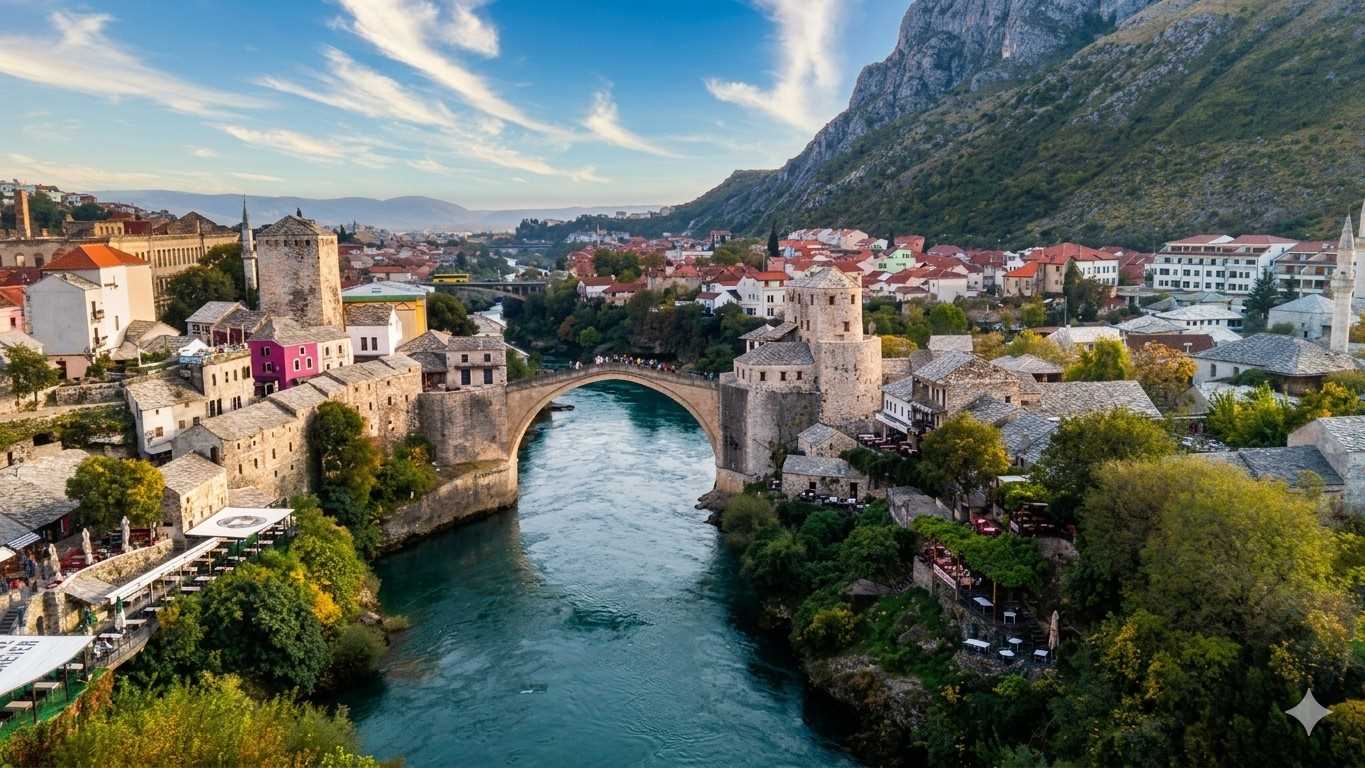
Mostar, Bosnia-Herzegovina Bus from Split takes approximately three hours. But border crossing can be a big unknown factor as Bosnia-Herzegovina is not part of the European Union. Mostar's Ottoman old town and the reconstructed Stari Most bridge are extraordinary — the combination of mosque minarets, Venetian-influenced stone architecture, and the river running through the middle of the city is like nothing else in the region.
In summer Mostar is crowded. In October it is significantly quieter and the light on the old town is at its most photogenic. A night here allows you to see the bridge and the bazaar without the midday pressure of day-trippers. The surrounding region has excellent Herzegovina wines — quite different in style from Dalmatian varieties.
A note of honesty before this section: the islands in October are not the islands of July. This is either the point or a problem, depending entirely on what you want.
Brač Car ferry from Split to Supetar takes 50 minutes — the ferry docks right at the Supetar bus station, which is genuinely convenient. Arriva buses connect Supetar with most of the island's towns and villages, though in a survey of island visitors public transport scored only 3.19 out of 5. Some of the island's most popular spots — Vidova Gora, Blaca Monastery — are far from bus routes, and there are no night buses. Frequencies reduce significantly in shoulder season. The honest assessment: Brač by public transport is doable but requires planning and patience. Bus tickets can be bought online at arriva.com.hr.
What makes Brač worth the effort for the right traveller:
Škrip is the oldest village on the island — a living museum of Dalmatian stone architecture with foundations dating back 1,500 years BC. The Island of Brač Museum here houses a Roman mausoleum said to contain the wife and daughter of Emperor Diocletian. The museum is open year-round in morning hours. Bus from Supetar to Škrip runs regularly.
Eco-Ethno Village Dol near Postira is a medieval village of roughly a hundred inhabitants, surrounded by natural caves that were once human dwellings. The "Viver's Path" leads through the village past caves, a 4th-century church of St Peter, and stone houses that tell the story of island life over centuries. Local legend speaks of "vivers" — mystical beings said to protect the village, heard rushing through the caves at night. Reachable by bus from Supetar via Postira.
Vidova Gora at 778 metres is the highest point on any Adriatic island. The view from the summit — across the sea to Hvar, Vis, and on clear days to Italy — is genuinely extraordinary. The hiking trail from Bol is well-marked and takes approximately 2.5 hours each way. Reaching it by bus requires getting to Bol first (bus from Supetar, approximately 1 hour) and then hiking up. For those willing to put in the effort, it's one of the finest viewpoints in Dalmatia.
Hvar Ferry from Split (Jadrolinija year-round, reduced frequency). Hvar town in October is quiet in the best sense — the lavender fields are long finished but the light on the old town is beautiful, the harbour is no longer choked with yachts, and the restaurants that remain open are the ones that serve people who actually live there.
Two ways to arrive: car ferry from Split to Stari Grad (2 hours, all year round), or catamaran from Split to Stari Grad (1 hour, seasonal) or Hvar Town (1 hour, seasonal). Both work; your choice determines where you start.
Hvar has two UNESCO sites — a rare distinction for a single island:
Stari Grad Plain was laid out by ancient Greek colonists in the 4th century BC and remains in agricultural use today, its original field divisions preserved in dry stone walls for 2,400 years. UNESCO listed it in 2008. It is one of the oldest continuously farmed landscapes in the world and one of the most overlooked UNESCO sites in Croatia.
Hvar Town itself contains one of the oldest municipal theatres in Europe and a 16th-century Venetian fortress. Its harbour in July is one of the most photographed — and most crowded — in the Adriatic. In October, it returns to something closer to a real town.
Cazmatrans buses connect Hvar Town and Stari Grad in 20 minutes, running up to four times daily and timed to connect with some ferry arrivals. Tickets are bought from the driver, cash only, no advance booking needed. The practical implication of your suggestion: arrive by catamaran to Hvar Town, explore, take the bus to Stari Grad (and the Plain), return to Split by car ferry from Stari Grad. Two UNESCO sites, one island, no backtracking.
Vis The furthest inhabited island from the Croatian mainland — approximately 45 kilometres offshore. Ferry from Split year-round. In October, Vis is very quiet. Services are reduced. Some restaurants are closed. This is not a problem if you are going for the right reasons.
Vis was a closed military zone from the 1940s until 1992 — no foreigners permitted, island residents required special permits. After WWII, Yugoslav leader Josip Broz Tito turned the island into a key base of naval operations. Deep inside the island's cliffs and tunnels are abandoned barracks, bunkers, and lookout posts that once guarded Yugoslavia's western frontier. The most remarkable of these is the Jastog submarine tunnel in Parja Bay — an 80-metre tunnel carved directly into rock, big enough to shelter submarines up to 110 metres long, invisible from the air.
Vis Special offers organised military history tours covering rocket shelters, bunkers, weapon-storage halls, submarine tunnels, the Yugoslav secret service communications headquarters, and Tito's Cave. In October, you will likely have these tunnels largely to yourself. Whether this feels atmospheric or slightly unsettling probably tells you something about whether Vis in October is the right choice for you.
The grape harvest runs from September through October across Dalmatia. Several wine regions are accessible without going as far as Pelješac.
Drniš area — inland from Šibenik, the Dalmatian hinterland produces distinctive wines from the Debit and Plavac mali grapes. Drniš is also the home of Dalmatia's finest pršut — dry-cured ham that rivals any prosciutto in Europe. Every year the town holds the International Pršut Festival, celebrating this tradition with tastings, local produce and the combination that defines Dalmatian hospitality: pršut, local cheese and local wine. The three together are not a starter — they are a complete experience. Check tz-drnis.hr for the festival programme.
Trogir area — the land around Trogir has a long winemaking tradition, less celebrated than Pelješac but accessible as an extension of a Trogir day trip.
For anyone seriously interested in Croatian wine, the harvest period is the obvious time to visit — wineries that are closed or unstaffed in summer often have their doors open and their owners present during berba.
For anyone planning to hike in Dalmatia — whether on Mosor, Biokovo, in the Cetina canyon, or anywhere else — two apps are worth downloading before you arrive:
AllTrails covers over 4,000 Croatian trails with difficulty ratings, elevation profiles, and downloadable offline maps. The offline function is not optional for remote trails where mobile signal is unreliable.
Komoot is particularly useful for multi-day route planning and has detailed user reviews for Croatian trails.
Both are free with optional paid upgrades. The paid offline maps are worth it.
Split has a growing cycling infrastructure that makes it possible to explore the city and coastal strip without a car, a bus, or much effort.
Marjan Hill is the most popular cycling destination for visitors. Bikes can be rented at the hill itself, and the paths around it are well-maintained and suitable for most fitness levels, with views over the city and the islands that justify the modest effort involved. A morning circuit of Marjan — before the heat arrives and before the walking tourists fill the paths — is one of the more pleasant ways to spend a first day in Split.
The coastal cycling path runs from the end of the Riva eastward — through Firule, Trstenik, all the way to Žnjan, a distance of approximately five kilometres of path that follows the coastline and connects the city's eastern beaches. The new Žnjan beach complex, completed in 2025, has a wide promenade from Ženta Marina to Dujilovo that is ideal for cycling, running or simply walking along the sea. An extension to Stobreč is under construction — check locally for whether it has opened by the time you visit.
Nextbike operates a public bike-sharing system throughout Split — stations at multiple points across the city, rentable via app, terminal or smart card. Pay-as-you-go rates start at €0.66 per 30 minutes. The app and a map of stations are available at nextbike.hr/en/split. For those who prefer to stay close to the city rather than taking a bus anywhere, a morning on a Nextbike along the coastal path costs almost nothing and covers ground that the walking itinerary misses.
For serious cyclists, Komoot lists cycling routes throughout the Split-Dalmatia region ranging from easy coastal rides to mountain trails. The Cetina Canyon route and the roads around Trogir are particularly well suited to road cycling in autumn when traffic is minimal.
Everything in this piece starts and ends in Split. The city is not merely a logistics hub for reaching these places. It is a place in its own right — one that rewards staying long enough to see it as something other than a collection of highlights.
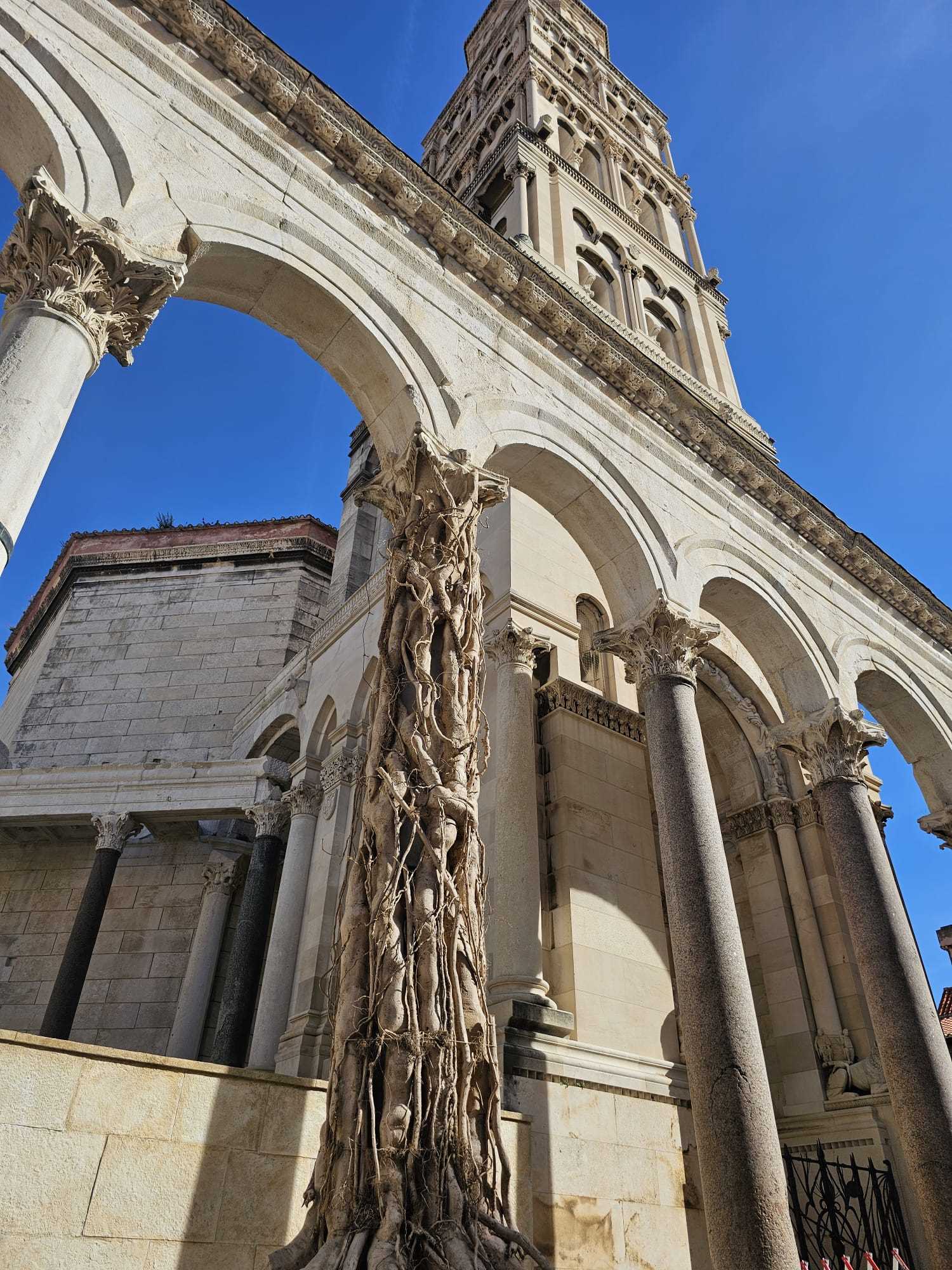
The morning walk or cycle from Bačvice to Žnjan before tourists arrive. Mass at Sveti Duje on Sunday morning. Fjaka on the Riva when you have nowhere particular to be. Aida in the Peristyle on a summer evening. A Hajduk match with Torcida in full voice.
These are not day trips. They are what happens when you stay long enough.
This is the second piece in a series on travelling Croatia slowly. The first — One Croatia Trip Is Never Enough — Here's How to Savour the Journey — covers regions, seasons and transport. The third — On and Off the Beaten Path — A Realistic Route Through Croatia — offers a framework for covering Croatia's main corridor. The fourth — What Google Can't Tell You About Staying in Split for a Week — is about staying in Split properly.
Valeria Teo has lived in Split's Radunica neighbourhood for over 15 years and holds Croatian citizenship. She operates 3 Flowers Holiday Rentals — rooms and apartments in central Split, all within walking distance of the ferry port, Diocletian's Palace and Bačvice Beach. For questions about planning a stay in Split or Dalmatia — which hiking club to contact, which ferry to take, or which week of October to aim for — she is a WhatsApp message away. threeflowerssplit.com