Some guests don't want a holiday from their habits. They want their holiday to include them. I've had guests ask, sometimes slightly apologetically, where they can find a gym during their stay — they're not interested in sightseeing for its own sake, they just don't want a week away from training to undo months of it. This is for them, and for anyone else who'd rather move than sit still.
It helps that Split is, by any reasonable measure, an unusually sporty city.
With a population of just over 200,000, Split has produced roughly 170 Olympians who have collected around 69 medals between them — a ratio that has led locals, not entirely jokingly, to call it one of the sportiest cities per capita in the world. The city's Olympic Walk of Fame began with silver medals won by footballers at the 1948 London Games and has been adding plaques ever since, covering water polo, swimming, basketball, rowing, tennis, weightlifting, handball and athletics.
Split-born high jumper Blanka Vlašić is a two-time world champion and the second-highest jumper in history. The basketball club Jugoplastika, based here, was named the best basketball team of the 20th century by FIBA. And the seaside tennis courts of TK Split at Firule produced four Top 10 players — Nikola Pilić, Željko Franulović, Goran Ivanišević and Mario Ančić. Ivanišević remains the only player in history to win the Wimbledon men's singles title as a wildcard entry, in 2001.
None of this is trivia for its own sake. It explains something real about the city: sport here isn't a tourist activity bolted onto a holiday destination. It's load-bearing in the local identity, which means the infrastructure for actually doing sport — not just watching it — is genuinely good.
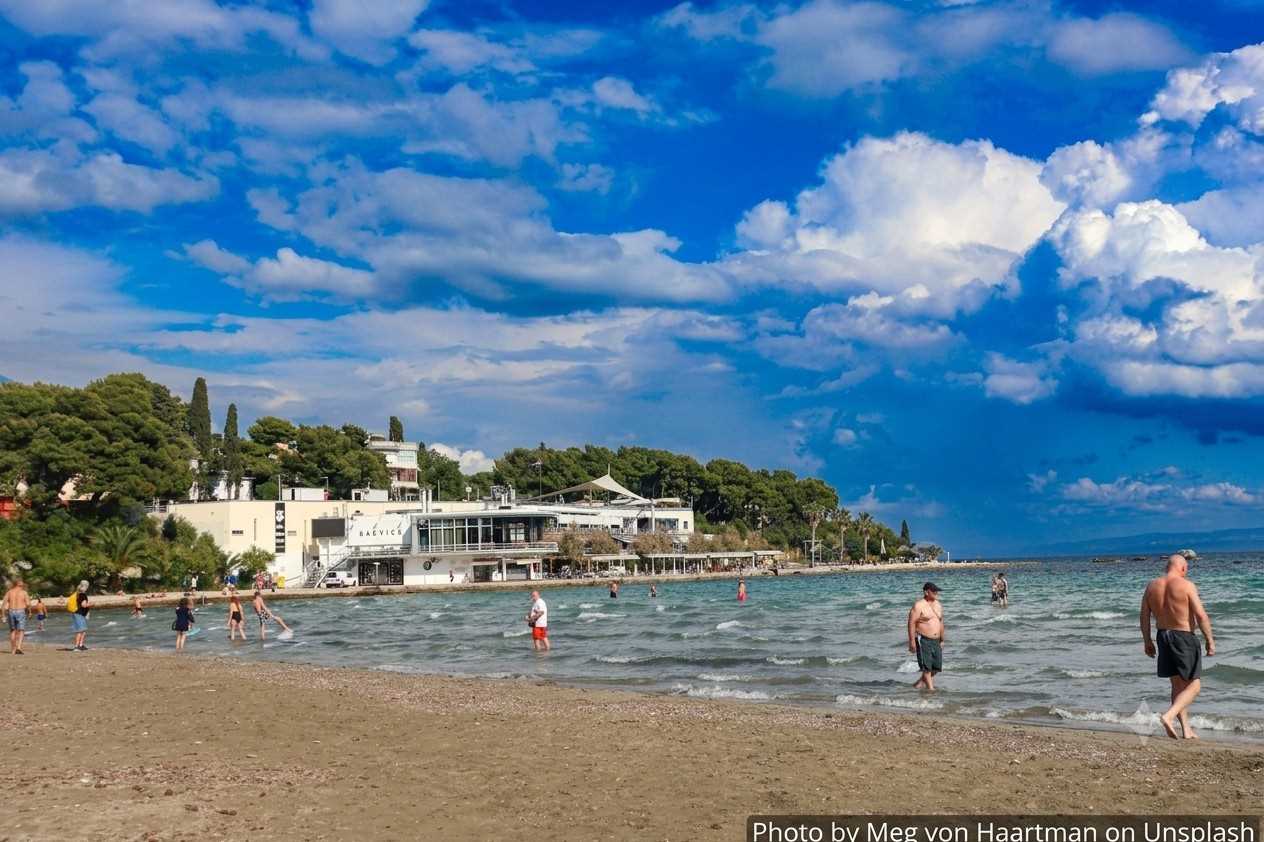
If you walk along Bačvice Beach at almost any time of year, you'll see it: small groups standing ankle-deep in the shallow water, batting a tiny ball between open palms, diving and leaping to keep it from touching the sea. This is picigin, and it was invented here.
The story goes that in 1908, a group of Split students returning from Prague tried to play water polo in Bačvice's famously shallow water and found it didn't work — there simply wasn't enough depth. So they improvised something else: no net, no score, no winners, just the shared goal of keeping a stripped-down tennis ball (called a balun) airborne for as long as possible, using nothing but the palm of the hand. It's been played here, more or less unchanged, for well over a century.
Locals will tell you, only half joking, that there are four things Split is genuinely proud of: Diocletian's Palace, Marjan Hill, Hajduk, and picigin. It's the only one of the four you can't visit — you have to play it, or at least watch it being played properly, which happens on Bačvice daily, in every season, including a long-standing tradition of a New Year's Day match regardless of how cold the water is. There's been an annual World Championship since 2005, judged on style rather than score, because the game was never built to be won — only played well.
You don't need to organise anything to see it. Walk along Bačvice on any given afternoon and it's almost certainly happening.
Split Fitness Club is the closer option to our apartments, a few minutes' walk away. Straightforward equipment, no fuss, ideal if you want a session before heading out for the day without losing the morning to transport.
Gyms4you is part of a larger Croatian chain with several Split locations, and the advantage of being open 24 hours a day, 365 days a year. If your training schedule doesn't follow normal hours — early before the heat, or late after a full day on your feet — this solves the problem entirely.
Beyond either gym: the coastal path from Bačvice through Firule to Žnjan is a genuinely good running or cycling route, flat and scenic, best done early before the heat and the crowds. Marjan Hill offers proper trail running if you want elevation.
Pickleball Club 002, located in Stobreč just outside the city centre and a short walk from the beach, has twelve professional courts and is, by its own and several visitors' accounts, the largest pickleball centre in Europe. It runs open play sessions, rentals, a pro shop and a genuinely active community — reviewers mention bringing friends back on return visits and travelling specifically to play there. Courts are booked through the Sporty+ app.
If you've never played, the appeal is real: pickleball is easy enough to pick up in an afternoon and dynamic enough to hold a serious player's interest. For travellers who want a structured, social, slightly competitive way to spend a few hours that isn't sightseeing, this is an unusually good option for a city this size.
Tennis remains available too, at the same Firule courts that produced four Top 10 players — playing where Ivanišević once trained is its own small thrill even if your serve doesn't resemble his.
Split has a particular talent for combining physical activity with eating and drinking, which is either the most sensible or least sensible national trait, depending on your perspective.
Mačak, a sports-entertainment centre and bar, packs cageball, mini-bowling, pickleball, billiards, table tennis and darts under one roof, with a genuinely good craft beer selection upstairs. It's the kind of place that works equally well for a competitive afternoon with friends or a low-key evening that happens to include some bowling. Open daily 8am to midnight.
Stara Mama, a billiards venue paired with a pizzeria, follows the same logic in a more food-forward direction — a proper pizza alongside a few competitive frames, which is a combination Croatia seems to have decided makes perfect sense and, having tried it, I agree.
If you want something more physically demanding than a gym session, Omiš — forty-five minutes from Split by bus — is where to go.
Ziplining here is genuinely one of the best in Europe: eight cables totalling 2,100 metres, the longest a 700-metre run at 150 metres above the canyon floor. The full course takes roughly three hours including a short uphill walk to the first line and instruction at the start. Guides are consistently praised for safety and patience with nervous first-timers — and plenty of visibly nervous first-timers do it anyway and are glad they did. Wear proper shoes; there's a genuine physical component beyond simply clipping in.
Rafting on the Cetina River covers the lower section of the canyon, mixing white water with calmer stretches for swimming, cliff jumping, and a stop at a cave with stalactites along the way. It's adaptable enough for families and tame enough for non-swimmers to enjoy, while still offering a proper adrenaline hit on the livelier sections.
Several operators combine the two into a single day — rafting in the morning, ziplining in the afternoon, transport included from Split. Given the bus from Split takes about forty-five minutes either way, a combined tour is the more efficient option if you only have one day to give it.
Beyond rafting and ziplining, the wider Cetina Canyon offers kayaking for those who want full control over their route, canyoning for a more immersive hike-swim-scramble combination, and a hike up to Fortica or Mirabella fortress above Omiš for those who'd rather earn their adrenaline with a 30-minute climb and a view instead.
For something that trades the canyon for the hills, several operators run ATV quad tours, jeep excursions, horseback riding and kayaking trips into the Dalmatian hinterland directly from Split, without needing to first travel to Omiš. These work well as full-day outings — kayaking paired with a jeep tour, for instance — and reach scenery most beach-and-Palace itineraries never touch: the inland countryside just behind the coast, usually finished with a homemade picnic. Worth considering if you want a day that's active but not in the same canyon as everyone else.
None of this requires being a serious athlete. It requires only being the kind of traveller who'd rather spend an afternoon moving than sitting — and Split, almost uniquely among cities this size, has built itself around exactly that instinct for generations. The Olympic medals on the Walk of Fame and the new pickleball courts in Stobreč come from the same place. The city plays as hard as it competes.
Valeria Teo has lived in Split's Radunica neighbourhood for over 15 years and holds Croatian citizenship. She operates 3 Flowers Holiday Rentals — rooms and apartments in central Split, all within walking distance of Diocletian's Palace, Bačvice Beach and the ferry port. If staying active is part of how you holiday, she's happy to point you toward whatever fits. threeflowerssplit.com