Every year, without fail, it happens.
A guest arrives in Split glowing with anticipation. They have spent eleven months in a grey northern city dreaming of this — the Adriatic sun, the blue water, the warm stone, the outdoor cafés. They are ready. They have packed the swimwear. They have the island day trips planned.
By day two, they are sitting in the shade of their apartment, slightly dazed, the colour of a well-cooked prawn, applying after-sun lotion with the quiet desperation of someone who has learned something the hard way.
I have watched this happen every summer for fifteen years. And every time, I think: nobody warned them properly.
So consider this your warning. Given with affection, but also with the complete seriousness the subject deserves.
Let's start with the numbers, because they tend to shock people.
Split's UV index reaches 8–10 from June through August. For context, the World Health Organisation classifies anything above 8 as "Very High" — the same category used for tropical destinations. The Dalmatian coast sits comfortably in the same UV bracket as the Costa del Sol and the Portuguese Algarve — places most people associate with serious sun.
The difference is that most visitors to those destinations have been warned. Somehow, Croatia's reputation is still more "medieval city breaks and island hopping" than "bring SPF 50 or face consequences." The sun doesn't care about your itinerary.
And it starts earlier than you think. By late May — before most people consider it "proper summer" — the UV index in Split is already firmly in the High range. I have had guests get sunburned in May. On a partially cloudy day. While wearing a light cardigan and thinking they were being sensible.
This one catches people every single year, and it is perhaps the cruelest trick in the Adriatic's arsenal.
Clouds block heat. They do not, in any meaningful way, block UV radiation. Up to 80% of UV passes straight through standard cloud cover. So on a day that feels pleasantly mild — overcast sky, gentle breeze, temperature a comfortable 24 degrees — your skin is receiving almost the full UV assault of a clear day, without any of the sensory warnings that would normally tell you to find some shade.
Guests have come back from a boat trip on a cloudy May afternoon looking like they'd spent a week in the Sahara. They genuinely cannot understand what happened. What happened is that they were deceived by comfortable temperatures into forgetting about the sun entirely.
The rule is simple: check the UV index, not just the temperature forecast. On a partially cloudy day in Split between May and September, assume the UV is high. Because it almost certainly is.
Even if you know about UV in the abstract, Split has specific features that amplify the effect beyond what you might experience elsewhere.
The limestone. Diocletian's Palace — where you will inevitably spend several hours wandering — is built almost entirely of white Dalmatian limestone. This stone reflects both light and heat with remarkable efficiency. You are not just receiving sun from above. You are receiving it from the walls, the ground, the steps. It is, in effect, a beautiful outdoor oven that has been running for 1,700 years and has no thermostat.
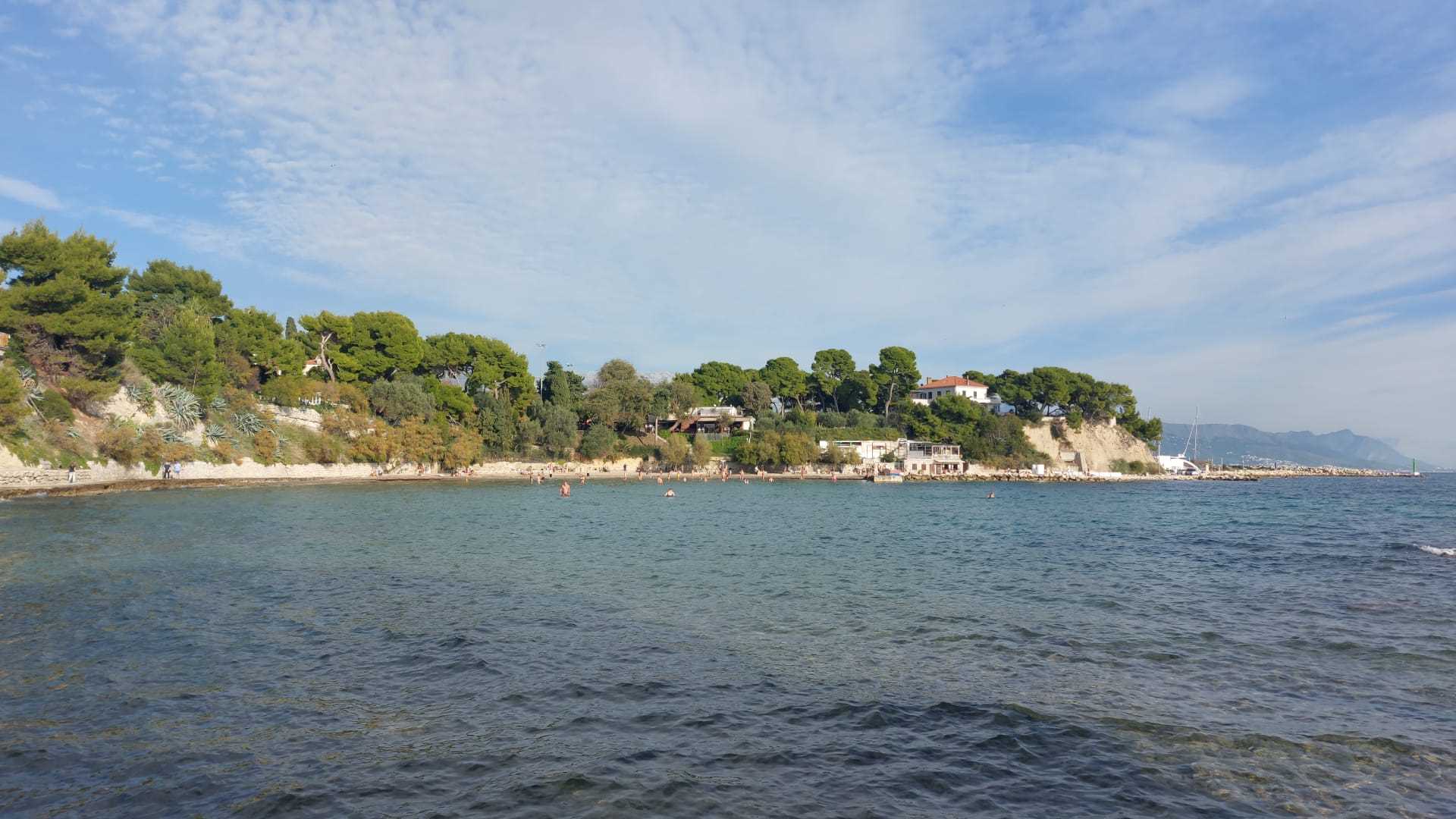
The water. The Adriatic is famously clear — among the clearest seawater in Europe. This is wonderful for swimming and visibility. It is less wonderful for UV protection, because clear water reflects UV radiation back upward at significant intensity. Floating on your back in the Adriatic while the sun shines overhead means UV from two directions simultaneously. The cool temperature of the water masks how much exposure you're getting. Two hours that felt refreshing can produce a burn you won't see until the evening.
The lack of haze. Many coastal destinations have atmospheric haze that filters some UV. The Adriatic air, particularly in the morning, is extraordinarily clear. There is nothing between you and the sun.
There is a reason why Mediterranean cultures developed the concept of siesta. It was not laziness. It was a rational response to living with a sun that, between roughly 11am and 4pm in summer, is genuinely trying to harm you.
Watch what local Split residents do in July. They are not walking along the Riva at 2pm. They are not pushing strollers through Diocletian's Palace at noon. They are not doing the island ferry tour that departs at 10am and returns at 5pm without a hat in sight. They are inside, or in deep shade, eating lunch, resting, waiting for the heat to pass.
Tourists, bless them, do all of the above. I have watched visitors push prams across the white stone of the Peristyle at 1pm in August and felt a profound sympathy — both for the parents, who will shortly understand their mistake, and for the baby, who has no say in the matter at all.
The hours before 11am and after 4pm in Split are genuinely lovely. The light is beautiful, the temperature is manageable, the crowds are thinner. These are the hours for sightseeing, for long walks, for the Old Town. The hours in between are for the beach (with shade and frequent water breaks), for lunch, for a rest. This is not a compromise. This is the correct way to experience Split.
Sunscreen, and not the SPF 15 you found at the back of a drawer. SPF 30 as a minimum for incidental exposure. SPF 50 for the beach, the boat, or any time you will be in direct sun for more than twenty minutes. Reapply after swimming — water removes sunscreen with cheerful efficiency regardless of what the bottle claims about being waterproof.
We keep sunscreen in all our apartments for exactly this reason. It gets used. Every year.
A hat with an actual brim. A cap protects your face from above. It does not protect your ears, your neck, or the back of your head — all of which will burn. A wide-brimmed hat is not a fashion statement. It is armour.
Water, and more water than you think you need. The heat in Split is dry rather than humid, which means you don't always feel yourself sweating as much as you are. Dehydration in this climate is easy to underestimate. If you are doing any significant walking — Old Town, Marjan Hill, the market — carry water and drink it before you feel thirsty.
Light, covering clothing for midday. A long-sleeved linen shirt is cooler than a t-shirt in direct sun, counterintuitive as that sounds. It blocks UV while the fabric breathes. The Dalmatian wardrobe has always known this.
Shoes with actual soles. The stone of Split in July reaches temperatures that make flip flops a genuinely questionable choice for any walk longer than fifty metres. The Peristyle, the Riva, the steps down to the beach — all of these surfaces absorb and radiate heat in ways that will make themselves known through thin rubber soles. Sandals with proper straps and coverage are both more comfortable and considerably safer.
The ferry to Hvar takes about an hour each way. In July, that hour on the open deck of a ferry, on the open Adriatic, at midday, is an hour of unobstructed UV exposure with sea reflection from below and sky from above.
Many guests do the island day trip and come back with the ferry tan — a distinctive burn pattern that covers every exposed surface from the knees down and the collar up, with sharp lines where clothing ended. It is not a flattering look. More importantly, it is a sign that something went wrong that didn't need to.
For island trips: bring everything. Hat, sunscreen, a light long-sleeved layer for the crossing. You can take it off when you arrive and find shade. The ferry deck gives you nowhere to hide.
These are, in many ways, the best months to visit Split. The crowds are smaller, the restaurants are easier, the prices are lower, and the temperature is perfect for walking.
The UV does not share this assessment. May and September UV in Split is still firmly in the High range — lower than August, but more than enough to burn an unprotected visitor in under an hour of midday exposure. The trap in shoulder season is that the pleasant temperatures make it feel safe. It isn't. The same rules apply, just with slightly more margin for error.
Split is one of the most beautiful places in Europe to spend a summer. The sun is part of that beauty — the quality of light on the Adriatic, the warmth on the stone, the long golden evenings — these are real and worth every effort to get here.
The sun is also, between roughly May and September, a serious force that deserves serious respect. Locals have fifteen centuries of accumulated wisdom about how to live alongside it. The wisdom is: shelter between 11 and 4, cover up, drink water, and never underestimate a partially cloudy day.
Your holiday will be significantly better if you arrive knowing this rather than learning it from the inside of a pharmacy on day two.
We want to see you leave Split with great memories. Not with the particular walk of someone whose shoulders have turned against them.
3 Flowers Holiday Rentals operates rooms and apartments in central Split — steps from Diocletian's Palace, Bačvice Beach and the ferry port. We check in every guest personally, which is how we know exactly how many of you arrive without sunscreen. We keep some in every apartment. You are welcome to use it. threeflowerssplit.com